
The 2026 World Series of Poker is underway, but fans might have been left in the dark trying to find information about it. The WSOP, in its infinite wisdom (/off sarcasm), has decided that people don’t need to read about what is going on without downloading an app that is notoriously wonky and difficult to use. The broadcasting efforts for the WSOP, under the auspices of GGPoker, are a mixed bag, with both improvements and failures.
No More PokerGO…
Live broadcasting of the 2026 WSOP is now available on YouTube, at least until ESPN picks up coverage (when that will be is unknown), and the price is perfect…free. Gone are the days of paying PokerGO for their paywalled coverage of the tournament. On the downside, the dedicated WSOP YouTube channel only presents select coverage. That “select coverage” is something that many are complaining about, however.
First, the 2026 WSOP coverage did not begin until Friday. This ignored the fact that other tournaments were going on, such as the $5,000 Eight Handed No Limit Hold’em tournament (Event #2) and the $1,500 Omaha Hi/Lo 8 or Better tournament (Event #4), which featured WSOP legend and three-time bracelet winner Perry Green making the final table at the youthful age of 90 (he would eventually finish in sixth place), earlier in the week. They could have started coverage on Wednesday, picking up these two events, but for some reason, TPTB at GGPoker (the owners of the WSOP) decided it was not worth the time.
They decided that the first ‘big money’ tournament of the schedule required coverage, and overall, it wasn’t too shabby. The $25,000 Heads-Up No Limit Hold’em World Championship began on Friday afternoon (Pacific Time), and the arena set up for the competition put previous WSOP stage presentations to shame. Gone is the “Mothership,” and in is the “Death Star,” as a massive floor area has been reserved not just for two or three featured tables but for multiple tables capable of televised coverage. This was an excellent move by GGPoker, and especially with the Heads-Up event, it allowed them to cover several tables simultaneously.
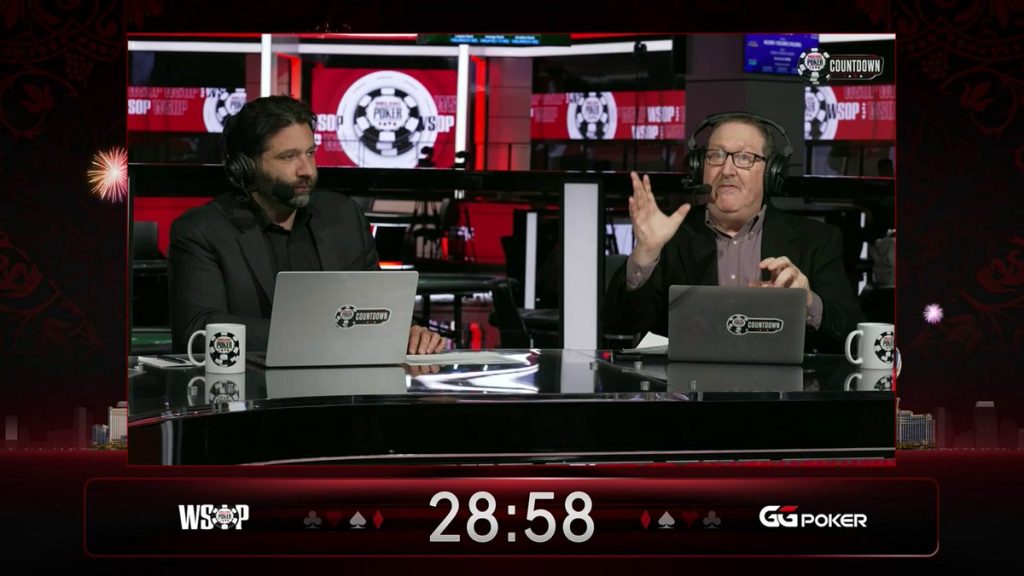
The inaugural broadcast on YouTube opened with “WSOP Countdown,” a show featuring several commentators for the 2026 WSOP discussing the upcoming action for the day. Jeff Platt, David Williams, Joe Stapleton, and Norman Chad took on the role of Shaq, EJ, Kenny, and Chuck (from Inside the NBA coverage) for poker, and overall, it was not too cringey. Some of Stapleton’s jokes failed to hit, and the taped coverage of the program (it was not live) seemed a little artificial; it would have been better if it had been done live.
Poker’s Fandom Tarnishes YouTube Coverage
The downsides of the 2026 WSOP coverage (Ali Nejad and Williams were the play-by-play and color commentators for this Heads-Up event) were not with the announcers or the floor staff’s work. The directors of the YouTube coverage kept the action moving among the sixteen tables that ran Day 1A of the tournament. For their part, Nejad and Williams were only caught off guard when they were plopped into situations where they didn’t have the information to comment on (reasons for a particular move by players, betting patterns, previous play at the table, etc.). What was embarrassing about the YouTube coverage was the inability to monitor the event chat for those who chose to partake of the coverage through their computers rather than their televisions (yes, I would rather watch on my massive HDTV than the keyhole of my cellphone or computer).
The ability to control the chat in a given situation, especially when presenting a YouTube event, is critical to ensuring everyone has a pleasant viewing experience. Poker’s fandom has a problem with YouTube chats – they tend to show the juvenile, and sometimes downright obnoxious, sides of the fandom. This was apparent through coverage of the Heads-Up tournament on Friday night.
The match between loudmouth Martin Kabrhel (WSOP, note for you: get control of this moron quickly, or you are going to end up with another William Kassouf situation) and Masato Yokosawa was simultaneously entertaining (Yokosawa played an excellent heads-up match) and infuriating (virtually everything about Kabrhel). It was Kabrhel’s racist actions on the table that not only should have been addressed by WSOP personnel but also brought out the racists in the online chat.
YouTube chat is notorious for people who seem to think they can say anything and that it is permissible. In the case of Kabrhel (who was ridiculing Yokosawa’s Japanese heritage with constant “Konishiwa” comments and bowing; and Kabrhel, a note to you: the dealers do not need to be “allowed” by you to do a DAMN thing), the racists in the WSOP chat room were rampant. Some in the online chat thought Kabrhel’s actions weren’t problematic (they were), and the monitors in the chat did little to shut down the racist commentary from those mental midgets in the chat room.
If poker is going to be an accepted competition on a mainstream stage, it needs to eradicate such actions in its chats and public discussions. If the world of football (soccer to those in the States) can stamp down racist commentary in their massive crowds and teams, then the little ol’ WSOP can do the same thing in its tournaments and chat rooms for its coverage. It is idiotic that, in the 21st century, organizations like GGPoker and the WSOP cannot control their players or their crowds. Alas, Kabrhel will not be around unless he reenters on Day 1B of the Heads-Up event after being eliminated by Yokosawa.
I could complain about how late the show ran, but that is my fault for being on the East Coast while the tournament is on the West Coast. The big match of the Heads-Up Day 1A was a battle between 17-time WSOP bracelet winner Phil Hellmuth and current World Champion and four-time Poker Players’ Championship winner Michael Mizrachi, but it didn’t come on until almost 4 AM on the East Coast; needless to say, I was asleep by the time these two titans went to war (spoiler alert: Mizrachi was able to defeat Hellmuth and move to the final eight of the Day 1A festivities).
With all of this said, I am personally happy that the WSOP is back and available for free on YouTube and ESPN. Some nitpicky things could be improved in the coverage (Stapes, you need to work on some of the one-liners), but the broadcast team’s coverage was quite good, and the poker was covered well. I am sure that the broadcasts will improve over the coming weeks at the 2026 WSOP.