
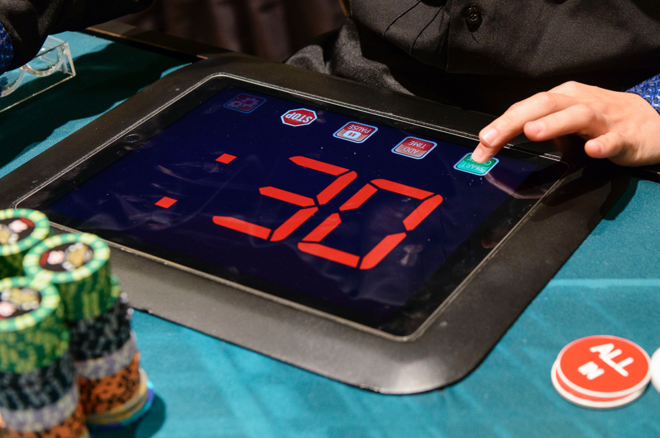
This is what is known as the “lull” in the tournament poker calendar. It is after the completion of the World Series of Poker, but it is before any real tournament action has resumed. Thus, we get sidetracked by little things like this, a playful spat between World Poker Tour Executive Tournament Director Matt Savage and Poker Hall of Famer Daniel Negreanu about what a proposed timing mechanism will be called WHEN, not if, it is employed by major tournament poker organizations.
Shot v. Action?
Savage, who has been one of the formative figures in tournament poker in the 21st century, is always one who wants to find out what the thoughts of the “Average Joe” in tournament poker are. After the 2025 WSOP, and the antics of several players (not naming names, but it rhymes with Bill Massouf), Savage has been seeking the pulse of many as to whether an “Action Clock” should be instituted. In the WPT, the tournaments utilize a thirty-second clock, called an “Action Clock,” because a player must complete their action – call, raise, or fold – within that time frame.
In an interview with PokerOrg, Negreanu let his thoughts be known on the discussion. When the subject of stalling at the tables – pushing the envelope on how long you take before you make a decision – came up, Negreanu was quick to say that it isn’t a part of poker. “Stalling is not a poker play,” Negreanu said in the interview. “It has nothing to do with the game, which means it is, by definition, an angle shoot.”
Where Negreanu differed from Savage was in the solution to the problem – somewhat.
Negreanu believes that something like a “chess clock,” which has a time bank allocation to make decisions, would be appropriate. These styles of clock would give a bulk amount of time to decide their play, in order to make sure that players were not taking an inordinate amount of time and delaying the game. One thing that he disagreed with Savage on, however, is what it would be called.
“I’m not calling it a f*****g ‘action clock,’ just because Matt Savage wants us to call it an action clock,” Negreanu playfully(?) jousted. “F**k him and the f*****g action clock…it’s a shot clock. That’s better. ‘Action clock’ my ass.
Savage naturally took the ribbing in his usual understated fashion. He would reply to Negreanu’s statements by rallying the poker community behind him on the site formerly known as Twitter:
Time For the “Clock” to Begin
Whatever it is called, ‘action’ or ‘shot’ clock, it is obvious that poker has reached the point where such a device is necessary.
Poker players are always the ones who will push the edges of the rules. Especially when it comes to making decisions, players will try to make it seem as if they are agonizing over a decision that, if the cards were face-up, the action to take would be quite easy. To keep these lengthy decisions from infringing on the game – especially on the money bubble, or during play once the money is reached – the WPT (and other organizations, such as the PokerGO Tour) have instituted what they call an “Action Clock.”
The basics of the “Action Clock” are that a player will have thirty seconds to make a decision. The player will also have a certain number (usually five) of “time extension” chips, which add another thirty seconds for each chip used. Once the chips are gone, the player must decide their action within the original thirty seconds, or their hand is declared dead.
The usage of the clock has normally been saved for just before the money bubble, and once a tournament is in the money. During the WSOP, however, several players abused the decision-making process, either to “Hollywood” for the PokerGO cameras or to irritate their opponents. Using a clock from the start of a tournament, as Savage has suggested, would eliminate these actions, as players would not have unlimited time to make their decisions known.
There are downsides to using the clock, however. If every player were to take their full thirty seconds, that would make each hand a four-and-a-half-minute process just to get through pre-flop decisions, let alone play afterward. Playing twelve hands an hour is not desirable by any poker player, so some way of eliminating constant usage of the full clock would have to be established.
Whether it is an “Action Clock” or a “shot clock,” it is good to see that there is agreement between players (as represented by Negreanu) and tournament personnel (such as Savage) that the time has come to implement it. Now we just need to figure out what to call it…


