
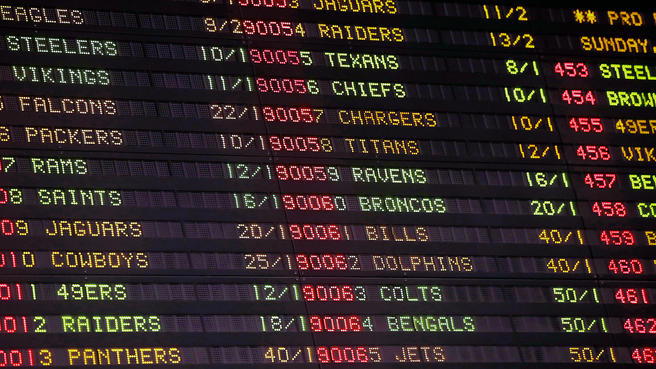
In the good ol’ U.S. of A., thirty-nine states, plus the District of Columbia and the territory of Puerto Rico, have enacted regulations that allow for sports betting, either live, online, or both. It has generated millions of dollars, if not billions, in revenue for the different states that offer the activity to their citizens. After the recent actions by the federal government regarding the activity, including the indictment of a current NBA player for betting against himself, we could be on the verge of significant changes in the U.S. sports betting industry.
Improper Bets Started it All
First, let’s look back at what caused these issues.
Last week, the U.S. Department of Justice arrested Miami Heat guard Terry Rozier on charges of wire fraud and money laundering, stemming from actions that occurred in 2023 (we’re not going to look at Portland Trail Blazers’ coach Chauncey Billups here, since his was a simple poker scam; the acts by Rozier and others are more impactful). In a game in March 2023, Rozier pulled himself out of a game, telling team officials that he had a foot injury. He would not return to that game, something that (allegedly) many people had placed money on.
What these bettors were wagering on were proposition bets, or “prop” bets. Prop bets are betting on whether a team or player will hit specific milestones in a game; it can be the team total for a team in a game or, if you’re betting on an individual, it can be on the number of points they score, whether they hit a homer, how many yards they get, or many other outcomes. These are arguably the backbone of sports betting, as people enjoy wagering on more than whether one team beats another. In Rozier’s case, he was under his projected totals – the “over/under (O/U)” – that had been set on his performance.
Apparently, this was not the only game, either. The Washington Post cited seven games that occurred after this Rozier game and were, in the federal government’s eyes, suspicious for players’ performance and for wagering on that performance. In one of those games, Billups admitted to people that the Blazers were “tanking” games (to earn a chance at a better draft pick) and that certain players, including superstar guard Damian Lillard and center Jusuf Nurkic, would not play. According to reports at the time, Lillard and Nurkic were listed on the injury report as probable (Lillard) and questionable (Nurkic) before being pulled only an hour before game time.
All these indictments come on the heels of one of the most embarrassing incidents in NBA history. In April 2024, then-Toronto Raptors forward Jontay Porter received a lifetime ban from the league for several violations of the policy regarding gambling. In particular, Porter allegedly (he was never charged in the matter) told gamblers that he would only play for “limited periods” in certain games, and placed bets totaling $54,000 on NBA games that he wasn’t a part of (another violation of the league’s gambling policies).
In the NBA, everyone also remembers the name Tim Donaghy. Donaghy is a disgraced former NBA official who used his position to influence game outcomes in the NBA between 2005 and 2007. Donaghy would end up pleading guilty to conspiracy to commit wire fraud and transmitting wagering information through interstate commerce in August 2007; he would be sentenced to fifteen months (and three years’ probation) in federal prison for his actions.
Another Threat Looms on the Horizon…
Suppose you believe that sports betting is not an issue. In that case, another form of wagering is going to pose some problems for the states – the proliferation of “prognostication markets.”
Prognostication, or prediction, markets are financial transaction methods somewhat akin to proposition betting. In a prognostication/prediction market, you are putting some money into a “financial proposition” that is dependent on the outcome of a sporting event. If you win, you get your investment back, plus the profit from a correct prediction. Unlike sports betting, such prognostication/prediction markets are legal across the U.S., mainly because the individual states haven’t caught up with this new form of wagering.
The New York Times reports that, in September alone, these prognostication/prediction markets have “traded” $2.5 billion in “contracts” on the prediction market Kalshi. Kalshi is so bullish on the growth of its business, free of regulatory burdens or restrictions, that it signed Poker Hall of Famer Daniel Negreanu to promote it. Kalshi also states that, because they are trading in a “commodity,” they are not subject to gambling regulations.
That may be changing in the future. Nevada Senator Catherine Cortez Masto flatly states that, “What they’re (prognostication/prediction markets) doing is essentially calling sports betting by another name, and that’s just wrong.” In 2023, Kalshi was prevented from offering “contracts” on sporting events, but that changed after the 2024 Presidential election and its outcome. In 2025, the prognostication/prediction markets are allowed to operate in a “Wild West”- style setting, with little to no oversight from federal or state regulators.
How Will the Leagues Change the Game?
The different sports leagues have been thunderstruck not only by their players’ actions in the sports betting arena but also by the federal government’s reactions.
In 2018, the Professional and Amateur Sports Protection Act (PASPA) of 1992 was overturned by the U.S. Supreme Court. Because of the law, every professional and collegiate league or organization had rules that outlawed betting on sports by its personnel. Still, Nevada was able to enact sports betting regulations, as one of the few U.S. states with legalized casino gaming. Once that law was overturned, however, the leagues had to study how it would affect their operations.
One of the biggest things professional and collegiate athletics share is game integrity. If the public doesn’t believe that the games are being contested legitimately, then it threatens to destroy what the bodies have created. Thus, they have been extremely vigilant in their handling of players, coaches, and other personnel who have violated their gaming rules.
Although there are prohibitions on players, they rarely affect major players in the game. In the Rozier situation, unnamed co-conspirators offered information about the health of top players, including LeBron James, Anthony Davis, and other NBA stars. These “leaks” aren’t being given for free; it is time to start punishing not only the lower-level players and staff but also the superstars (anyone remember when it was Los Angeles Dodgers’ outfielder/pitcher Shohei Ohtani’s translator who was making bets, not Ohtani?), unless it can be definitively proven that these players did not know about the actions.
The individual leagues would be wise to use this to tighten up their rules on sports betting. It might also behoove the individual teams that have sponsorship arrangements with these sportsbooks (if that doesn’t scream “lack of integrity,” what does?) to immediately end the contracts and demonstrate the integrity they claim to have. As of January 2025, 87 franchises across the four major sports (the NFL, the NBA, MLB, and the NHL) had sponsorship arrangements with one of the seven sportsbooks licensed for operation in the U.S.
How Can This Change Sports Betting in the U.S.?
Although they are offering a legal product, the U.S. sports betting industry will face significant challenges over the coming year.
In some states, it is illegal to place prop bets on certain sporting events. In Florida, Hard Rock Bet customers can wager on the outcomes of collegiate sporting events, but they cannot place any prop bets on those games or on players on the playing surface. This has been enacted in other states to reduce pressure on college students and the potential for harassment from those who have lost bets because of a 19-year-old’s performance. Still, a majority of states lack protection against this activity. The elimination of prop betting could become epidemic throughout the U.S., as states look to curb the activity and gain control over the wagers being offered.
In other states, prohibition on advertising sports betting options has become the way to control the game (no pun intended). In 2024, New York Representative Paul Tonko and Connecticut Senator Richard Blumenthal introduced legislation to prohibit advertising during sporting events and to eliminate prop betting on collegiate athletes. The American Gaming Association disagrees with this approach, citing existing regulations on sports betting and the tax revenues that have flooded state coffers since sports betting was legalized.
With forty-one different rules and regulations on this issue, it is unlikely that any uniformity will be achieved without Congressional action. Even if some federal regulation of the industry were passed, it would likely be challenged in court for another decade. That would give the sports betting industry more opportunities to strengthen its position in popular culture and the sporting arena.


